News
Dispatches from the project. Every entry links through to the fuller story on the team's own sites.
Upcoming
Talk
Harnessing AI for Nature at Stanford
Sam Reynolds has been invited to a Stanford University Uncommon Dialogue on harnessing AI for nature, alongside a small group of participants, with a guest lecture and departmental seminar planned around the visit.
Recently
Workshop
AI and rapid evidence reviews at the DEFRA data festival
Sam Reynolds leads a workshop at the DEFRA Group Data and Information Festival in London.
Milestone
Evidence TAP finds a home at Pembroke
The project is now hosted at Pembroke College as the Evidence Traceable Accountable Pipeline, funded by the MacArthur Foundation to generalise the approach to new fields. Sam Reynolds, Mélanie Gréaux and Sadiq Jaffer joined the College as Associate Scholars.
Media
Filming the Conservation Copilot for ai@cam
Sam Reynolds and Lynn Dicks filmed a short ai@cam video on the Conservation Evidence Copilot, on how it can help conservation decision-makers embed evidence into their decisions.
Milestone
The corpus passes 20 million full texts
The Evidence TAP database grew to around 20 million full texts. The team also refined the downloader so that it respects publishers' stated preferences about how their papers may be mined.
Milestone
Conservation Evidence Copilot enters private preview
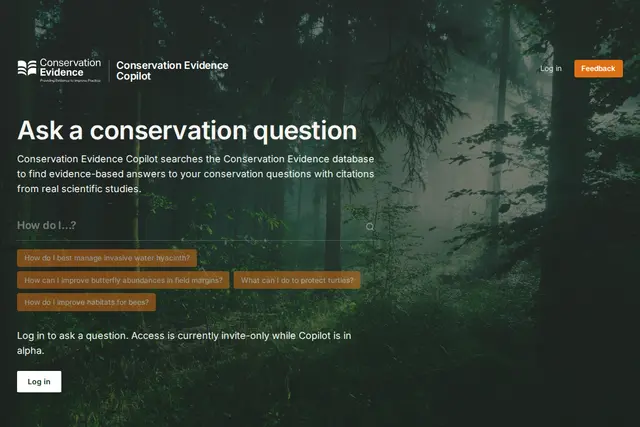
The Conservation Evidence Copilot, which searches the Conservation Evidence database to answer conservation questions with cited scientific studies, opened to invited testers in an invite-only alpha. If you would like to trial it, please get in touch with Sam Reynolds (sar87@cam.ac.uk).
Milestone
The Conservation Copilot takes shape
The team advanced the Conservation Copilot, a layer over the evidence-synthesis pipeline, in step with a major overhaul of the shared paper storage and classification infrastructure that underpins it.
Milestone
Building the literature pipeline for Evidence TAP
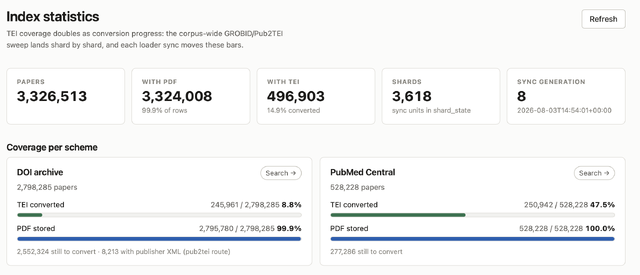
The team began building the pipeline that gathers and organises the research literature. A custom downloader works through publishers' access requirements, and an index over millions of papers gives the Copilot secure, local access to the collection.
Milestone
A public home for Evidence TAP
With growing interest from policymakers in living evidence databases, the project began putting together this public website to explain the approach.
Paper
Principles for responsible AI in conservation
Sam Reynolds led a preprint with conservation-AI researchers worldwide. It has been submitted to Conservation Science and Practice.
Milestone
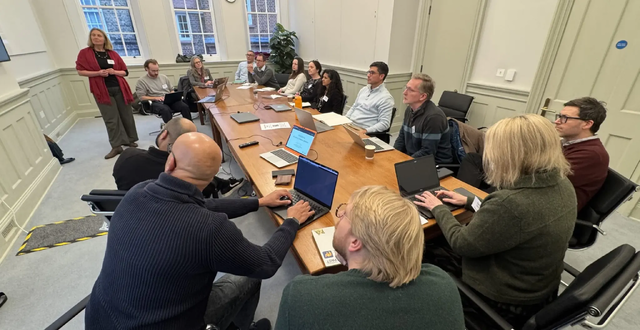
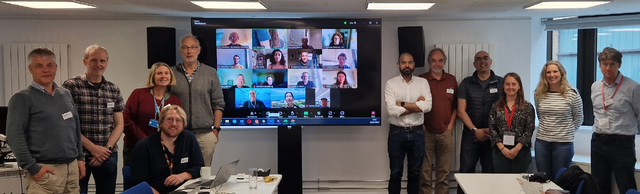
Evidence TAP takes shape
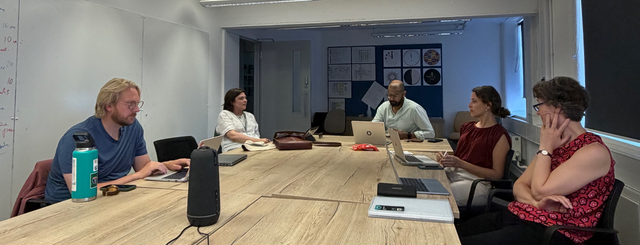
With the paperwork now finalised, regular project meetings got under way. Eleanor Toye Scott joined to organise the living evidence database design requirements, working alongside the conservation and education teams.
Talk
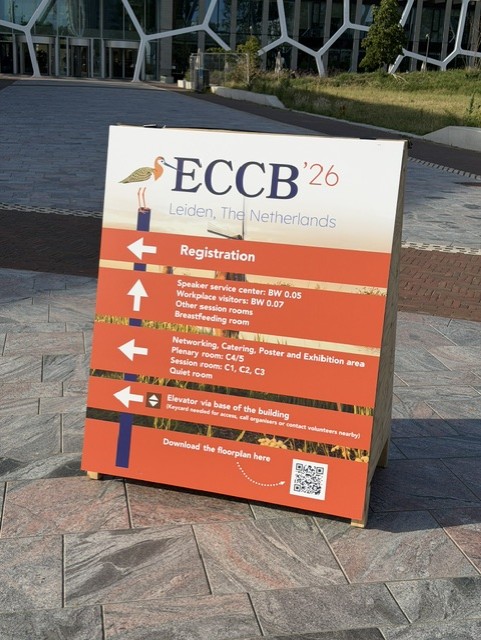
Plenary panel at ECCB 2026
Sam joins the plenary panel on AI at the European Congress of Conservation Biology in Leiden, with live notes from the congress.
Talk
The Conservation Copilot demoed in Parliament
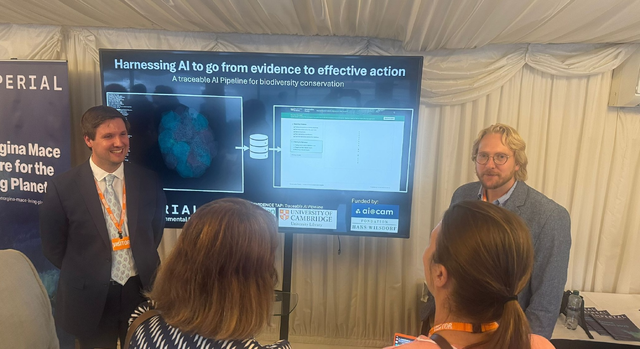
Alec Christie, Sam Reynolds and Sadiq Jaffer, with Bill Sutherland, demoed the Evidence TAP traceable AI pipeline at the Georgina Mace Centre for the Living Planet debate at the Houses of Parliament.
Talk
World Biodiversity Forum, Davos
Sam presented AI for reviewing conservation evidence at the forum in Davos, Switzerland.
Milestone
Evidence TAP kicks off
The project held its first meeting on broadening Conservation Evidence into education. Jenny Gibson and Mélanie Gréaux joined the team in Cambridge.
Milestone
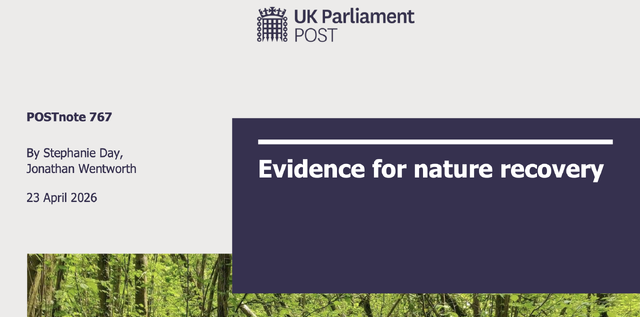
Evidence for nature recovery briefed to Parliament
POSTnote 767 reports on a briefing that Bill Sutherland, Lynn Dicks and Anil Madhavapeddy gave to the UK Parliament. It sets out how systematic evidence supports the Planning and Infrastructure Act 2025.
Talk
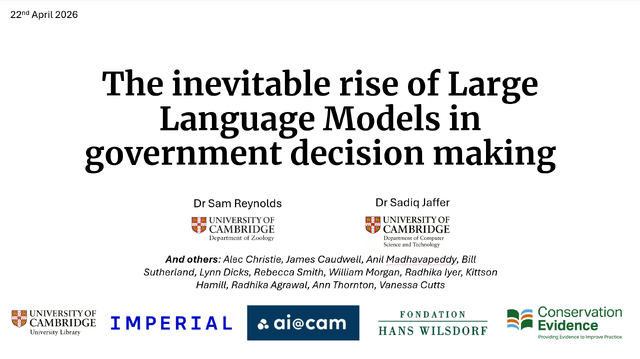
LLMs in government decision making
Sadiq Jaffer and Sam Reynolds spoke at the Digital Statecraft Academy on “The inevitable rise of Large Language Models in government decision making”, fielding practical questions from civil servants.
Milestone
Securing full-text access from publishers
The pipeline needs the full text of papers, with people checking its work along the way. Anil writes about arranging access with publishers, alongside evidence synthesis events at DESNZ and a Nature-hosted panel led by Sam.
Workshop
Evidence TAP at DEFRA's science conference
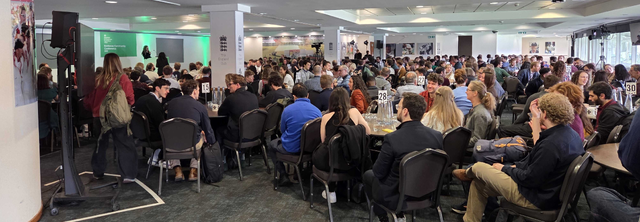
Sadiq Jaffer and Sam Reynolds ran an evidence-synthesis session for around 200 people at the DEFRA Science, Analysis and Data Professions Conference in London.
Media
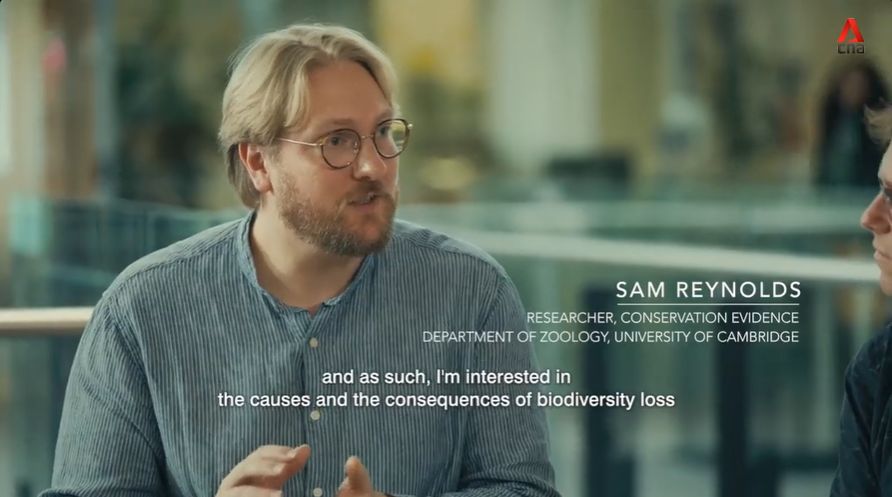
Channel News Asia documentary airs
Sam features in “Can AI genuinely improve human health and the planet?”, talking about the Conservation Evidence work to an audience of around 150 million.
Milestone
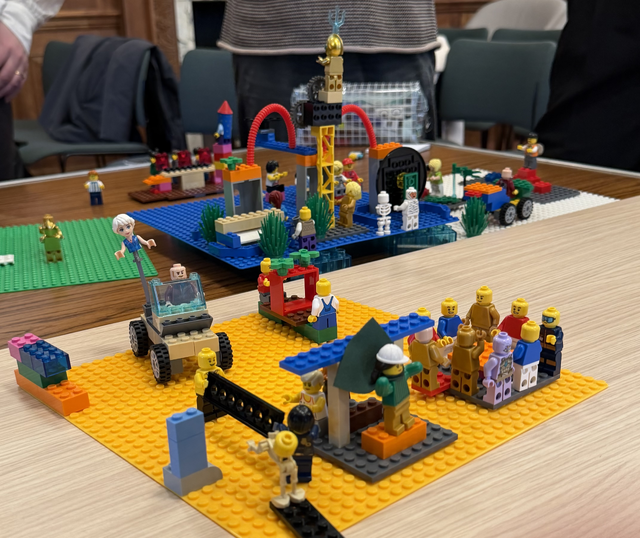
Designing the TAP, in Lego
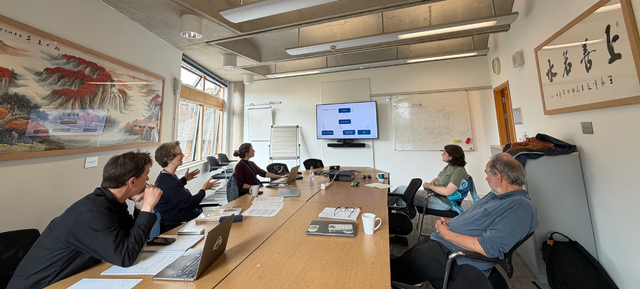
A facilitated Lego brainstorm brought together Computer Science, Zoology, Education, CSaP and CSER to plan the newly awarded next phase of the project.
Media
Nature: biodiversity's evidence problem
Nature reported from the Conservation Evidence conference on the plan for a constantly updated, AI-assisted evidence base with humans overseeing the process. A follow-up roundtable at the Parliamentary Office of Science and Technology came the same week.
Milestone
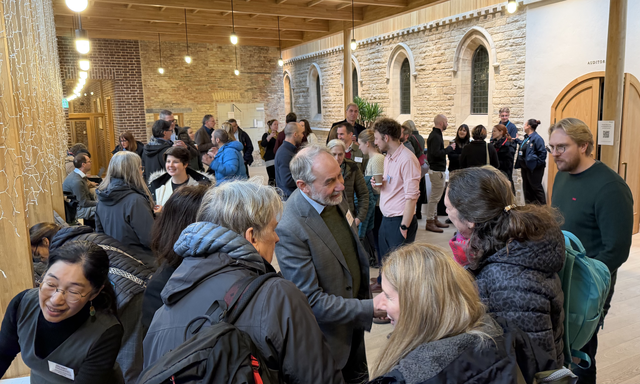
Evidence champions at Pembroke
The science leads of all five UK nature conservation bodies and the JNCC gathered in Cambridge to discuss evidence-led nature recovery.
Talk
Speaking at the AI4Nature launch
Anil Madhavapeddy spoke at the IET in London on how modern AI can help nature recovery, at the launch of the cross-sector AI4Nature initiative. He was invited by Sam, a founding member.
Workshop
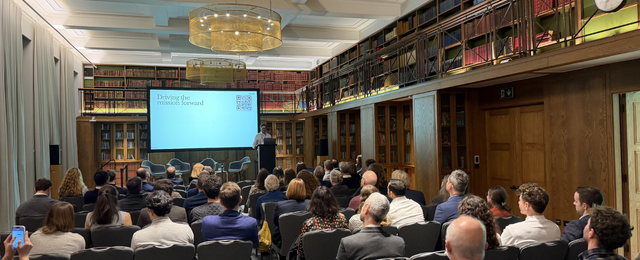
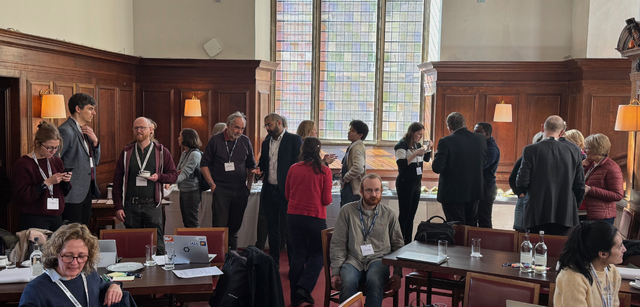
Conservation Evidence conference, Cambridge
The community gathered at Pembroke College; Sam spoke on using AI to understand what works in conservation.
Paper
Is AI poisoning the scientific literature?
Our comment in Nature proposes federated living evidence databases with human-in-the-loop review.
Milestone
Summer intern cohort joins the evidence work
Radhika Agrawal and Kittson Hamill joined the summer intern cohort, working on a human-in-the-loop framework for evidence-synthesis inclusion criteria and on summarising threats in the conservation evidence literature.
Paper
Out-of-the-box LLMs are not ready for conservation decisions
Our evaluation of LLMs for conservation decision support appeared in PLOS One.
Media
AI for Nature: embrace with caution
The University of Cambridge published a feature on the horizon scan and the Conservation Evidence AI work.
Workshop
AI for evidence synthesis workshop
Anil shares notes from our Cambridge workshop, held in the week a fully AI-generated paper first passed peer review.
Paper
AI and conservation horizon scan published
The community horizon scan of AI opportunities and risks for conservation appeared in Trends in Ecology & Evolution.
Paper
First preprint on LLMs for evidence-based decision support
The first results from evaluating LLMs against the Conservation Evidence literature became available as a preprint.
Talk
Conservation copilots at the CCI workshop
Anil spoke on copilots and embedding evidence into conservation decision-making at the Cambridge Conservation Initiative.
Media
Introducing the Conservation Evidence Copilots
Anil spoke to the AI@Cam team about the project's plan to accelerate a database built from over 1.6 million screened papers and 8,600 summarised conservation studies.
Milestone
Selected for the ai@cam challenge
The conservation evidence AI project was chosen as one of Cambridge's flagship AI research challenges.
.jpeg)